
This article contains affiliate links. We may earn a commission at no extra cost to you if you make a purchase through our links.
7 Best Smart Home Devices for Practical Home Automation in 2026
Introduction
The smart home market has matured considerably over the past few years. What started as a collection of disconnected gadgets with spotty Wi-Fi connections has evolved into a more cohesive ecosystem where devices actually talk to each other and deliver genuine value. But that doesn’t mean every smart device is worth buying.
The products on this list solve real problems: wasted energy, security gaps, and the tedium of manual control. We focused on devices that work reliably without requiring a master’s degree in networking, integrate with mainstream platforms like Matter and HomeKit, and deliver measurable improvements to daily life. We excluded gimmicks that look impressive in YouTube reviews but gather dust after two weeks.
We prioritized compatibility across different ecosystems, ease of setup, and long-term reliability over flashy features. Each recommendation includes honest tradeoffs because no device is perfect, and knowing the limitations helps you make the right choice.
1. Apple Home Pod Pro

The Home Pod Pro is Apple’s flagship smart speaker and home hub, combining high-fidelity audio with thread-based connectivity that strengthens your entire smart home network. Unlike its predecessor, it actually sounds good as a standalone speaker while serving as the computational backbone for HomeKit automations.
The design is understated—a tall cylindrical speaker with a touch-sensitive top. Setup is seamless if you use Apple devices; just bring it near your iPhone and it configures itself. The microphone array handles voice commands from across the room without shouting, and the spatial audio processing makes music sound immersive. If you run HomeKit, this device becomes essential because it enables remote access, automations, and notifications while you’re away from home.
The real strength here is Thread. This mesh networking protocol runs independently of your Wi-Fi, which means your automations keep working even if your internet temporarily drops. As more HomeKit devices adopt Thread, your network becomes more resilient. The built-in U1 chip also provides room-level presence detection, so your home can react differently depending on which room you’re in.
- Thread mesh networking makes HomeKit automations reliable
- Excellent spatial audio quality for music and podcasts
- Seamless integration with HomeKit; automations run locally on the device
- Temperature and humidity sensors built in
- Can act as a hub for multiple HomeKit homes
- Expensive at $300—costs more than most standalone speakers
- Requires HomeKit ecosystem; limited value for non-Apple users
- No screen means you can’t see information at a glance
Best for: Apple users who want a reliable home hub and are willing to invest in the HomeKit ecosystem.
2. Eve Energy Monitor

The Eve Energy Monitor plugs into your electrical panel and tracks power consumption across your entire home in real-time. This isn’t a smart plug that monitors one outlet—it’s a whole-house solution that disaggregates your energy use by circuit. You can see exactly how much power your HVAC, electric water heater, or refrigerator uses at any moment.
Installation requires a licensed electrician in most jurisdictions because you’re working inside your breaker panel. This is a minor hurdle, but it’s worth it. Once installed, you get a detailed breakdown of energy consumption in the Eve app, with historical trends and cost estimates based on your local utility rates. You can set alerts for unusual spikes—a sign your furnace is cycling excessively or an appliance is failing.
The device uses Thread for connectivity, so it integrates seamlessly into HomeKit. You can build automations around energy usage: turn off pool pumps when demand is highest, postpone water heater heating to off-peak hours, or get notified if a circuit draws unexpected power. The data is fascinating and often reveals inefficiencies you didn’t know existed.
- Circuit-level breakdown shows exactly where energy goes
- Historical data helps identify patterns and anomalies
- HomeKit integration enables energy-aware automations
- Works with any utility provider; calculates costs automatically
- Local processing means your energy data stays private
- Requires professional installation ($200-500)
- Only works with HomeKit—no support for other ecosystems
- Setup is complex; not a weekend DIY project
Best for: Homeowners serious about understanding and reducing energy consumption who already use HomeKit.
3. Nanoleaf Essentials 55-inch

Nanoleaf’s modular lighting panels have become the standard for programmable accent lighting. The Essentials line is the no-nonsense version: 16 million colors, thousands of preset scenes, and full HomeKit support. The 55-inch starter pack gives you a substantial canvas without requiring a second mortgage.
The triangular panels mount to your wall magnetically, letting you arrange them in whatever pattern you like. The adhesive backing is permanent, so plan your layout carefully. Each panel connects via ribbon cables, and the entire system is controlled from a single hub that plugs into power. Setup takes 20 minutes if you’re methodical about layout and cable routing.
The real value is reactive lighting. Music can sync to your lights, creating a nightclub effect in your bedroom. Scenes are highly customizable—you can program morning lighting that gradually brightens as you wake, evening lighting that shifts toward red to avoid melatonin suppression, or color cycling that matches your favorite band’s concert aesthetic. HomeKit integration means you can automate changes based on time of day, occupancy, or other conditions.
- Massive color palette and scene variety
- Music-reactive mode is genuinely fun
- Modular design lets you expand over time
- HomeKit automations integrate with other devices
- Local processing; colors sync without cloud dependency
- Permanent wall mounting means commitment to the layout
- Expansion packs are expensive ($60-80 per panel)
- Music sync quality depends on audio source; works better with some apps than others
Best for: Renters with creative freedom (removable walls) and anyone who wants dramatic accent lighting beyond basic RGB bulbs.
4. Arlo Essential Outdoor Security Camera

Arlo’s Essential Outdoor is a wireless security camera that runs on rechargeable batteries, eliminating the need to run power cables across your exterior. The build quality is solid—weatherproof with a 130-degree field of view. Recording happens locally to a hub, with optional cloud backup through Arlo’s subscription service.
The camera delivers 1080p video with night vision and detects motion, people, packages, and animals with reasonable accuracy. The detection engine isn’t perfect—you’ll occasionally get false alerts from moving shadows—but it’s significantly better than passive motion sensors. When triggered, you get a notification with a 15-second video clip and can view live video from your phone.
Battery life runs 3-6 months depending on activity level and temperature. Cold weather reduces efficiency, so expect shorter intervals in winter. The camera intelligently skips frames during low-activity periods to preserve battery, only recording when something interesting happens. You can recharge batteries in-place or swap in spares while one set charges indoors.
- No power cable needed; wireless installation is faster
- Battery lasts several months between charges
- Local hub recording means footage doesn’t disappear if your internet drops
- Smart detection reduces false alarms from wind and light changes
- HomeKit support available (with paid Arlo subscription)
- 1080p resolution is standard but not leading-edge in 2026
- Arlo’s subscription fees add up ($3/month per camera for basic cloud storage)
- Night vision uses IR, which creates a washed-out monochrome image
Best for: Homeowners who want wireless security cameras without running cables and don’t mind occasional false alerts.
5. Ecobee SmartThermostat with Voice Control
The Ecobee thermostat is a capable smart controller that works with most HVAC systems—heat pumps, gas furnaces, radiant heating, you name it. The display is clear and readable from across a room, and the built-in microphone handles voice commands without a separate Echo device nearby.
Installation is straightforward if your existing thermostat has a common wire. If not, Ecobee includes a power extender kit that solves this problem. Once installed, you configure heating and cooling schedules, set temperature preferences, and the thermostat learns your patterns over time. It adjusts based on occupancy detection from your phone and can lower temperature when nobody’s home to save energy.
The standout feature is remote sensor support. You can buy additional sensors (roughly $40 each) that measure temperature in different rooms, and the thermostat can heat or cool based on an average or specific room rather than just the thermostat location. This eliminates hot and cold spots in many homes. The app gives you detailed energy reports showing which days consumed the most heating or cooling and how that compares to historical averages.
- Works with nearly all HVAC systems without rewiring
- Remote sensors reduce temperature variance across rooms
- Detailed energy reporting shows consumption trends
- Voice control through built-in microphone
- Supports HomeKit, Alexa, and Google Home
- Display can be hard to read at an angle
- Additional sensors required for multi-room control ($40 per sensor)
- Learning feature sometimes creates unexpected schedule adjustments
Best for: Homeowners who want energy savings and even heating/cooling throughout their home without a learning curve.
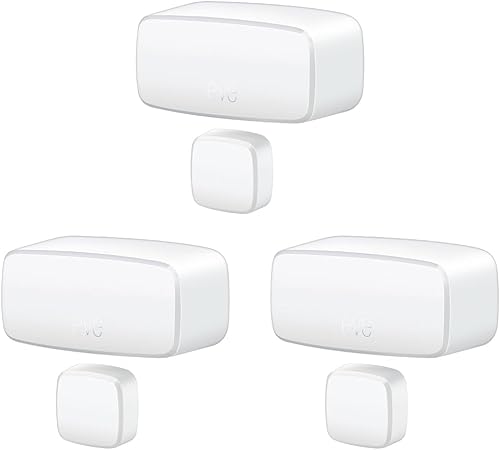
6. Eve Door & Window Sensor
Eve’s door and window sensor is the simplest smart home device on this list: a magnet-based contact sensor that detects when an entry point opens or closes. Despite its simplicity, it’s indispensable for security and automation. The sensor is small enough that it blends into trim, and the battery lasts over a year in typical use.
You mount it on any door or window frame—entry doors, garage doors, sliding glass doors, even cabinets. HomeKit integration sends immediate notifications if a door opens unexpectedly. You can build automations: turn on lights when the front door opens at night, lock the garage when the last person leaves, or send an alert if a window opens while you’re away.
The real strength is bulk deployment. Placing sensors on every entry point is affordable enough that you don’t have to choose which doors matter most. At $25-30 per sensor, a six-entry home costs under $200 to fully cover. The cumulative effect is powerful—you get notifications for all activity and can build sophisticated automations that respond to multiple sensors at once.
- Inexpensive; easy to deploy widely
- Battery lasts 12+ months; minimal maintenance
- Works with HomeKit automations for sophisticated scenarios
- Compact design blends into trim and frames
- Reliable; false alerts are virtually nonexistent
- HomeKit only—no support for Alexa or Google Home
- Automations require a home hub to function remotely
- No wireless range extension; relies on standard HomeKit mesh
Best for: HomeKit users who want comprehensive security coverage without breaking the bank.
7. Logitech Circle View Doorbell 2K

Logitech’s Circle View doorbell replaces your existing doorbell and provides a 2K camera that captures video when people approach your door. Unlike battery cameras, it gets power from your existing doorbell wiring, so there’s no battery maintenance. The 180-degree field of view captures people approaching from the side, not just straight on.
Installation requires turning off power at your breaker, removing the old doorbell, and connecting two wires to the new one. If you’re comfortable with basic electrical work, it’s a 15-minute job. The doorbell includes a mechanical chime so you still hear visitors through traditional means; you don’t need to listen through an app.
Video is captured locally to a hub or synced to HomeKit, with optional continuous recording through a subscription. Face recognition works reasonably well for familiar visitors, reducing notification fatigue. Package detection specifically recognizes deliveries, important because you get targeted alerts rather than being spammed for every person who walks past.
- Powered by existing doorbell wiring; no battery concerns
- 180-degree field of view covers approaches from sides
- Package detection is surprisingly accurate
- Mechanical chime backup means you never miss a visitor
- 2K resolution is clear for identifying faces
- Installation requires basic electrical work
- HomeKit integration requires optional subscription for continuous recording
- Wired doorbell systems aren’t compatible with some older wiring
Best for: Homeowners with existing wired doorbells who want upgrade without batteries or recurring charging.
Final Recommendation
The best smart home setup isn’t built all at once—it grows as you identify specific problems worth solving. Start with a central hub if you don’t have one (the Home Pod Pro), add sensors to your entry points (Eve Door & Window), and expand from there. These devices share a common thread: they solve practical problems reliably without requiring constant troubleshooting. That’s what separates genuine smart home devices from expensive clutter.